
ISSUE FOCUS: Spring Cover Crops in Agriculture — Win-Wins for Farmers and the Environment
I am a farmer and an environmentalist both, full stop. I imagine many people are.
I don't know a single farmer who is not interested in protecting soil from erosion and depletion. And in the past 20 years I've seen a new appreciation of the importance of soil health (microbiology) and soil building among farmers: we see evidence of this every spring, with more and more acres of cover crops throughout the countryside. I find this very encouraging!
I believe it is broadly agreed — among farmers and environmentalists both — that the greatest risk of nutrient loss — of nitrate runoff, surface and groundwater contamination — is in the months of April, May, and June. This is a time of year when (a) farmers (like me!) are applying fertility, (b) spring thaws and spring rains produce runoff on bare soils and, critically, (c) there is very often little plant matter (roots in particular) on fields to absorb and stabilize nutrients.
Planting overwintering cover crops like grain rye is one very good solution to this. We have been planting winter covers for decades at Featherstone Farm; they are planted in the fall, overwinter well under snow cover, then "green up" right away in the early spring, where they are a very good antidote to the kinds of nutrient (particularly nitrate) runoff that occurs this time of year. There are a lot of other benefits to soil health from overwintered covers; they "feed" soil microbiology and "release" naturally stored fertility in soils, that can be used by a commercial crop that follows (organic vegetables or conventional corn, and everything in between).
If this is the case, why have winter covers been so slow to catch on? And what might limit their growth in the future? The answers to this are the practical realities of farming, that I well understand after 30+ years of cover cropping myself at Featherstone Farm.
First, cover crops are expensive to establish and manage. It's not just the cost of the seed; it's the cost of taking the tractor out ($5+/gallon diesel!) and planting them in the fall, terminating them (chemically or with tillage) in the spring. There is real risk of winter rye "getting away from you" (the farmer) as well: a prolonged wet spell in, say, early April (not at all uncommon), can result in overgrown rye that is very difficult — and expensive — to terminate and re-incorporate. Featherstone Farm has been burned on this many, many times. Cover cropping requires intense, focused management; not all farmers have the time or capacity to do this.
Moreover, if it is difficult to quantify the financial return of cover cropping — in terms of added yield and risk management for, say, field corn (it is!) — then how does a farmer justify the additional expense and effort? Particularly if their margins are already very, very tight? (Production costs for a bushel of corn were already ~$4.70, before the recent spike in fertility and fuel costs.)
The answer to this question is complex, but I believe it is real and achievable. To illustrate that answer, think about where renewable energy generation stood just 25 years ago. Solar and wind power production (like cover cropping) had been around a long time on an experimental level. But when it came time to grow the technologies out to scale, a boost of public subsidy was needed. When Featherstone Farm put up 34 kW of photovoltaic power generation on its shed in 2011, we received significant low-interest loans from the State of Minnesota. This allowed us — and many, many others — to begin the long process of taking farm-scale solar mainstream.
Flash forward 15 years and, thanks to early public support, the cost of solar power has come down very dramatically; green power (particularly wind) is about the cheapest electron money can buy. The renewable power industry has become largely self-reliant. THIS is what I believe can and must happen with soil and water conservation strategies like cover cropping — a bit of public subsidy priming the pump of private industry, to make sustainable practices catch on.
With this in mind, I will be very actively promoting two existing programs already on the landscape in SE Minnesota. The first is the Olmsted Groundwater Protection Soil Health Program, and the second is the University of Minnesota's Forever Green Initiative.
The Olmsted Program — "created with farmers, for farmers" — is a three-part initiative (alternative crops, pasture enhancements, and particularly cover crop promotion) that has been transforming farming practices in Olmsted County for years. Importantly, it recently received a three-year LCCMR grant to expand to 11 additional counties in SE Minnesota, including the four counties of SD 26. This program is no longer in the research and development stage; it is actively transforming the landscape of the county already, in a way that protects groundwater and builds soil health: up to 40% of all FSA-certified farms in Olmsted participate in at least one of the program's three parts.
You can read more about the Olmsted County Groundwater and Soil Health program here.
If this initiative can be brought to scale in the coming years, it has huge potential to address groundwater protection now, in real time, throughout the area. As Minnesota Senator, I will work tirelessly to promote incentive-based programs like this, to jump-start environmentally friendly practices in agriculture — just as public subsidies jump-started renewable energy a generation ago.
BUT… I do not believe that public subsidies alone can or will incentivize farmers (like me!) to take on the additional expense and risk of cover cropping and other environmentally beneficial practices, long term. There has to be a real-world, practical financial reason to grow winter covers: they have to pay for themselves in more than just risk protection for the following season's cash crop.
This is why the University of Minnesota's Forever Green Initiative is so promising for the mid and long term. This program has been active for more than a decade. It is all about developing multiple perennial and winter-hardy cover crop varieties and strategies that are both practical and profitable — while protecting and restoring clean water at the same time.
You can read more about Forever Green here.
Field trials for some of the most promising Forever Green crops, like winter camelina, are now growing on thousands of acres across the state. There is work still to do on everything from seed variety and genetic development, to planting systems, to harvest and market development. But the potential is very significant, if we stay focused. As a Minnesota Senator, I will do just that!
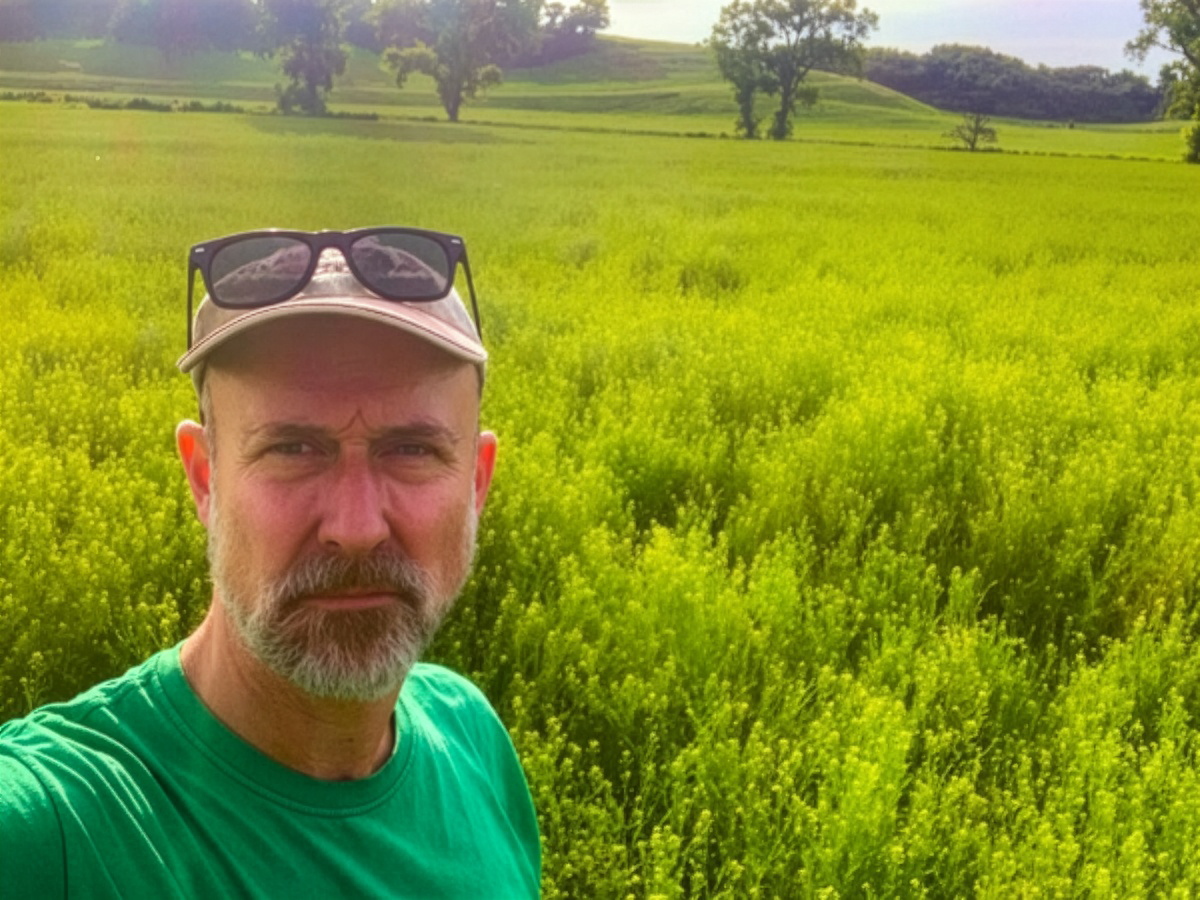
I visited with conventional farmer Paul Novotny outside Chatfield last night, understanding details of his winter camelina rotation.
This week I am visiting a grower just outside SD 26 — Paul Novotny, just north of Chatfield — to see his field of camelina in flower, and to understand the complex management and timing that he has developed to make it pay as well as protect soil and groundwater. Having planted and managed cover crops — annual, biennial, and perennial, all three — for decades, I will be able to understand both the challenge and the potential of the crops I see. And to learn from Paul what remains to be done to make the Forever Green Initiative expand to include more farmers and more acres in the future.
The issue of clean water — protecting domestic well water and surface waters for fish and game — is complex. But I've dealt with complex challenges on my own farm for 30+ years! WE CAN DO THIS. Using public policy to research and develop positive, proactive solutions that make sense for agriculture, rather than telling farmers what they have to do on their land — this is why the Olmsted Groundwater and Soil Health Program, and the Forever Green Initiative hold so much promise for me, and for the entire region and state. As they scale up, they will be clear win-wins for agriculture and for the environment.
As someone with three decades of planting and managing cover crops, I understand the risks and rewards for farmers. I believe many if not most of my neighbors in rural SE Minnesota will adopt these environmentally sound practices — sooner rather than later, voluntarily rather than mandated — if they can be shown to be practical and to contribute to the bottom line, financially.
